Choose Travel Words That Fit a Puzzle
Build a travel word search around one scene, then check names, lengths and spellings before generating the grid.
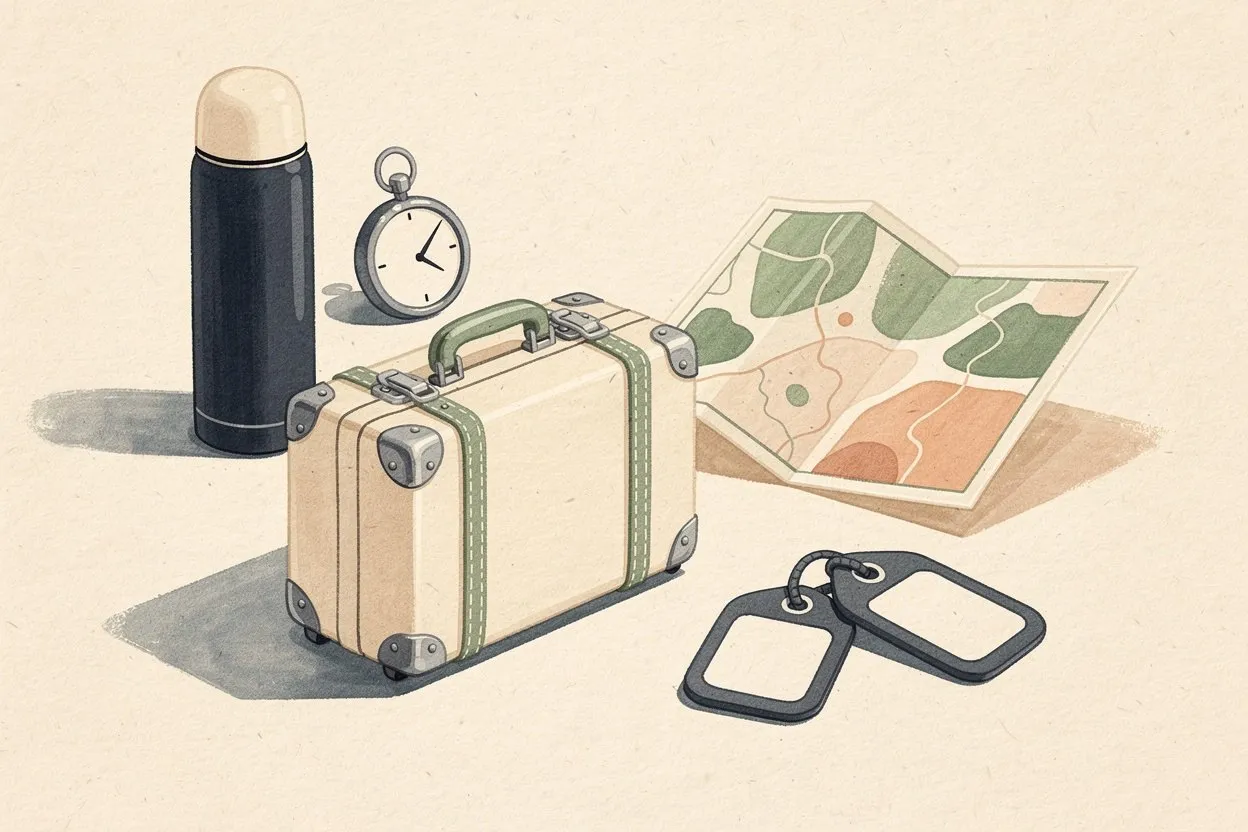
Travel offers many possible word-search themes, from a station platform to a small overnight bag. The strongest short lists choose one scene rather than trying to cover an entire journey. A focused theme gives players a useful expectation and helps you avoid filling the grid with unrelated place names, equipment and actions. Begin with the kind of trip you want the puzzle to suggest.
Choose a scene rather than a continent
A railway scene might use TRAIN, TRACK, TICKET, SEAT and PLATFORM. A bag-focused scene might use CASE, POUCH, SOCKS, JACKET and CHARGER. These are original example groups you can adapt; they are not a packing checklist or a complete vocabulary lesson.
Keep the title aligned with the words. If the theme is “at the station,” a suitcase can fit naturally, while an unrelated beach activity may not. A clear boundary makes the puzzle feel intentional even when the list contains only a handful of entries.
Use place names deliberately
Place-name puzzles need more checking than a list of everyday objects. Spellings, alternative names and punctuation can be sensitive or ambiguous. If your goal is a simple travel-themed game, common objects may be a better starting point than a list of cities selected only because their names are familiar.
When you do use a place name, verify its spelling from an appropriate source and inspect how the puzzle maker handles spaces or accents. Do not silently turn a name into a different-looking string and assume that every player will recognize the intended reference.
Keep the target list consistent
Decide whether words will be singular nouns, plurals or a mixture. A short scene can become confusing when one entry describes an object and another describes an action without a clear reason. Consistency is not mandatory, but it should be a choice rather than an accident.
Check repeated letters and endings carefully. A familiar travel word can be misremembered precisely because it feels obvious. Read the final target list after generation and compare it with your source list before inviting anyone to play.
Fit the words to the puzzle
Enter the list in the puzzle maker and choose a grid that can accommodate the longest target. Review any message about invalid or unplaced entries. Do not assume that the generator included every line simply because a grid appeared.
Try a few selections on the device you expect to use. A long diagonal word may be easy to spot but awkward to select on a small display. Use the game’s supported tap-based alternative when dragging is uncomfortable, and reduce the grid’s density if readability suffers.
Keep the game separate from trip preparation
A travel puzzle can provide a pleasant theme, but it should not be used as a checklist for documents, baggage rules or safety requirements. Those depend on the real journey and need current information from the relevant providers.
For play, the objective is simpler: a well-labeled theme, correctly spelled targets and a grid that works. Save the list if you want to make another version later, remembering that locally stored progress does not synchronize automatically between devices or browsers.