Group Hobby Words Into a Playable Theme
Choose a narrow hobby theme and a balanced word list that players can understand without specialist assumptions.
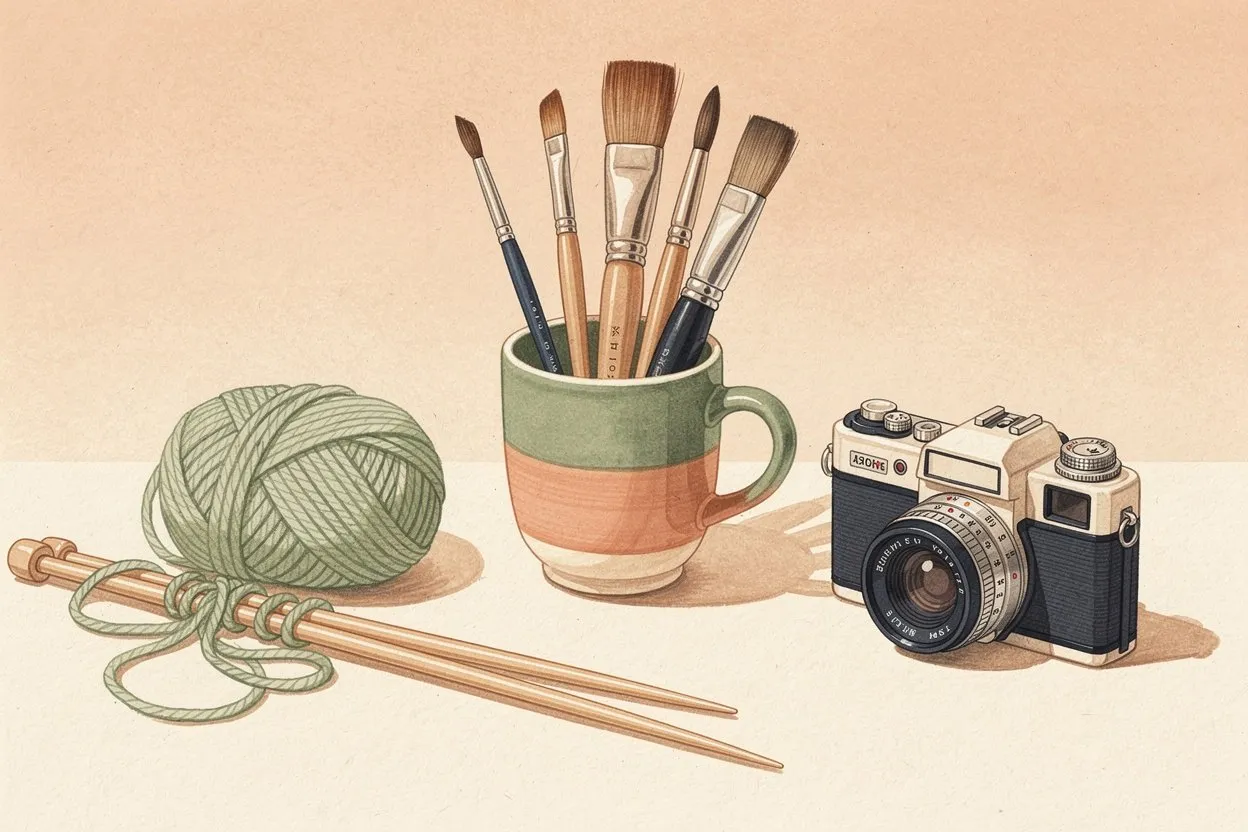
A hobby-themed word search works well when the words share a recognizable activity. It can be as focused as a watercolor table, a knitting bag or a camera walk. The challenge is deciding how much background knowledge the puzzle assumes. A few familiar terms create an approachable theme; a specialist list needs a clearer introduction and more careful spelling checks.
Choose the intended player
Decide whether the puzzle is for someone new to the hobby, a mixed group or an experienced enthusiast. This affects the vocabulary more than the number of words. A short list of obscure abbreviations can be harder to understand than a longer list of familiar objects.
For an introductory art theme, BRUSH, PAPER, PAINT, WATER and PALETTE form a coherent example. A knitting scene could use YARN, NEEDLE, STITCH, ROW and SWATCH. These lists illustrate how a shared scene can guide selection; you can write your own terms to match the activity you enjoy.
Keep one organizing idea
Avoid combining every hobby you know into one small list unless variety is the explicit theme. A camera, a paintbrush and a cooking utensil can all be leisure objects, but that broad category gives the player less useful context than a specific workbench or activity.
If you want a mixed collection, divide it into smaller puzzles. Each can have a clear title and a manageable set of words. This also gives you a reason to vary the visual theme without making the target list feel arbitrary.
Check terminology without copying a source list
Use your own selection of common terms. If you need to verify a specialist spelling, consult an appropriate reference, then write a list that serves your puzzle rather than reproducing a proprietary worksheet or published puzzle. Avoid using a commercial brand name merely to make a theme seem recognizable.
Decide how to handle abbreviations, compound words and plurals. Inspect the puzzle maker output to see how entries are normalized. A joined compound may remain readable, while an unexplained abbreviation may not be a satisfying target for the intended player.
Balance familiar and challenging words
Include a range of lengths that fits the chosen grid. A few short words can help a new player begin, while one or two longer words add variety. Do not use length as the only measure of difficulty: repeated common letters can make a short word less distinctive than a longer unusual sequence.
Play several targets yourself in the word search game. Check that the letters remain readable on a phone and that the selection method feels comfortable. Review any unplaced entries before calling the puzzle complete.
Describe the activity honestly
A hobby puzzle is a word-finding game, not proof of skill in the hobby. Avoid presenting completion as a qualification or making claims about health or cognitive improvement. Let the theme provide interest without promising more than the activity delivers.
Keep a separate copy of a favorite source list if you want to reuse it later. Local browser records are convenient, but they are not a cross-device account or a permanent archive.